
Open the street once: external coordination and the 20–40 % prize.
Parts 1 through 3 treated the sewer network as a self-contained optimisation problem. It isn’t. A defensible asset-management programme cannot ignore the fact that other actors — the municipal street programme, district-heating renewal, telecom rollouts, fiber installations, water-supply works — are operating in the same right-of-way on their own calendars. The optimum that ignores them is structurally inferior to the one that doesn’t, and the gap is typically 20 to 40 percent of lifecycle cost. This is the single most under-counted lever in municipal asset management.
Why the street is the cost
For most sewer rehabilitation methods, the pipe itself is a small fraction of total cost. The bulk of spend is street access: excavation, sheet piling, dewatering, traffic management, asphalt and surface reinstatement, restoration of curbs, signage, and landscaping. Even for trenchless methods like CIPP lining, the access shaft, traffic management, and bypass pumping dominate the unit cost.
A representative cost stack for an open-cut renewal of a 6-meter mainline segment in a built-up Finnish street: pipe and bedding ~10 %, labor and equipment ~15 %, excavation and dewatering ~30 %, traffic management ~15 %, surface reinstatement ~25 %, contingency ~5 %. Three-quarters of the cost is the hole and what happens around it — not the pipe.
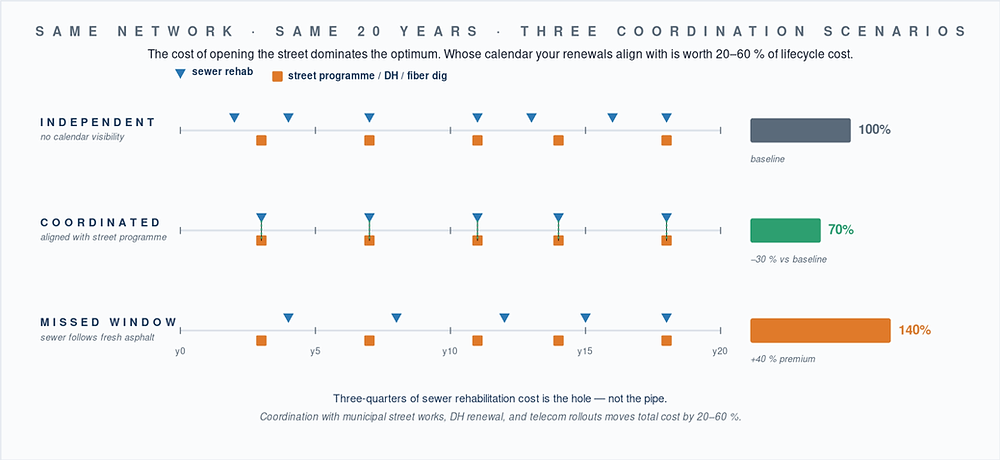
Figure 1. Same network, same 20 years. Independent scheduling sets the baseline. Coordination with the street programme saves 30 %; missing a coordination window costs 40 % more.
This is the structural reason coordination wins. If the street is already open for another reason, the marginal cost of doing the sewer work that day is the pipe plus labor — single-digit percentage of the standalone cost.
Three coordination cases
Case 1: Bundled with the municipal street programme. The city’s street office plans to repave a kilometer in 2027. If the sewer assets on that kilometer are due for rehabilitation in 2025–2030, pulling them forward to 2027 captures the shared excavation. Even if the pipes had three or four years of remaining service life, the cost saving from sharing the access typically exceeds the time-value of delaying renewal.
Case 2: Bundled with district-heating or telecom dig. DH and fiber operators dig long trenches on their own schedules. A utility with visibility into those plans 1–2 years ahead can adapt its rehabilitation programme to ride along — often at less than 25 percent of the standalone cost. This case is increasingly important in Finnish cities as fiber buildout and DH renewal both accelerate.
Case 3: The missed window. The opposite case: a street is resurfaced in 2027, and the sewer below it reaches replacement condition in 2028. Breaking the new street in 2028 carries a premium of 20–60 percent over having coordinated. Municipal politics typically forbid it for three to five years anyway, so the rehabilitation is deferred — at growing risk and growing eventual cost. The asymmetry matters: the saving from coordination and the premium for missing it are roughly the same magnitude.
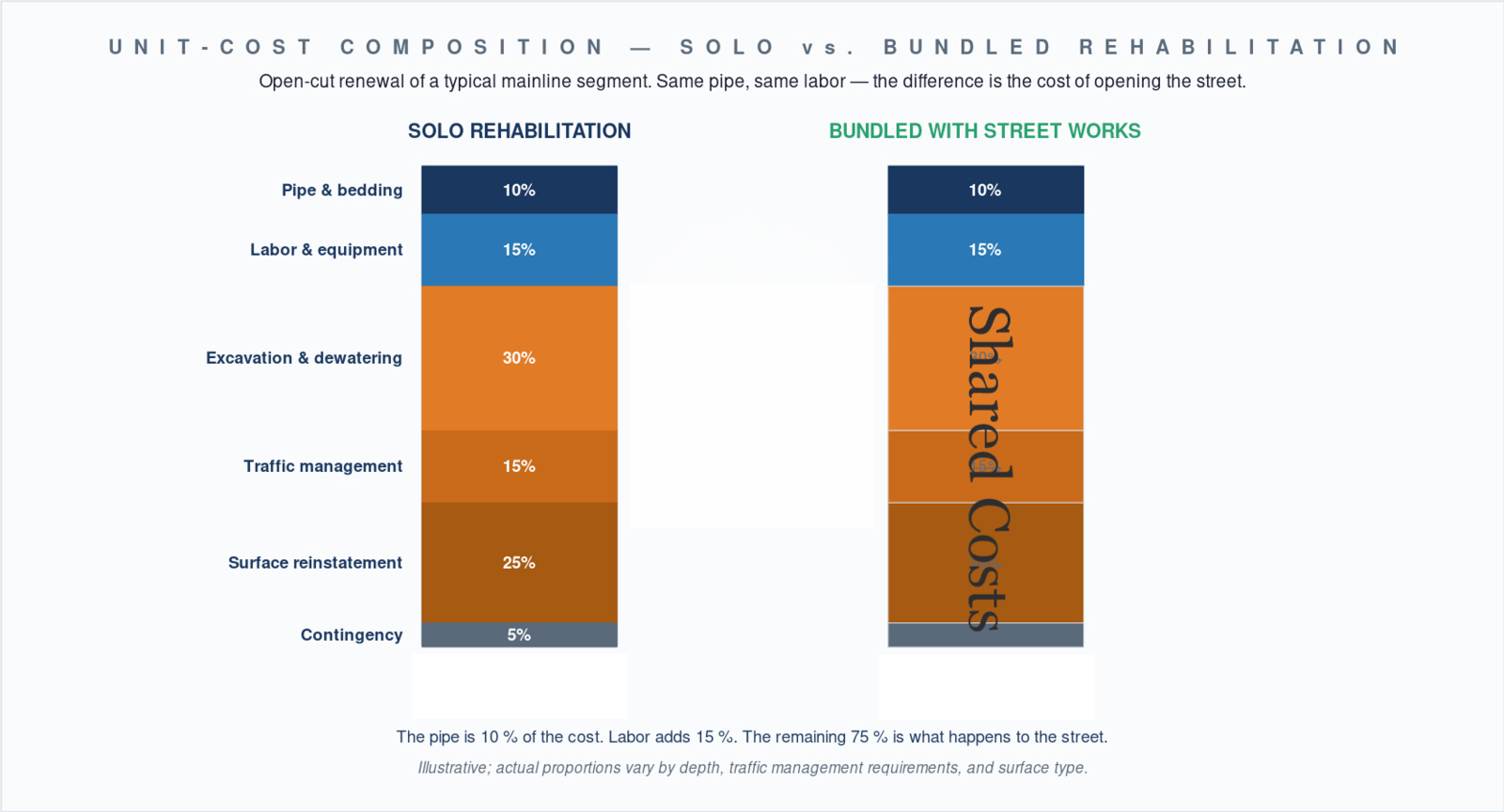
Figure 2. Same pipe, same labor — the difference is the cost of opening the street. When the access costs are bundled the savings are apparent and also the disturbance for street users is minimized.
Data discipline beats algorithms
The constraint is information. Most utilities know their own one-year rolling renewal programme; many can produce a three-year view. Few have any structured visibility into the corresponding three-year programmes of the city street office, the DH operator, or the telecom providers. Coordination begins where shared planning data begins.
The practical implication: a small investment in calendar integration — quarterly coordination meetings, shared planning portals, even a basic data exchange agreement — produces optimisation gains that an extra million euros of analytics does not. The binding constraint here is information flow, not algorithmic sophistication.
Three takeaways
-
The street is the cost. Sewer rehabilitation spend is dominated by access, not by the pipe. Plan around access opportunities, not pipe age alone.
-
Coordination has a price tag. The 20–40 % prize is real and measurable. So is the 20–60 % premium for missing a coordination window. The asymmetry is structural.
-
Information beats algorithms here. Visibility into other actors’ 1–3 year programmes is worth more than any incremental modeling sophistication. Invest in the data exchange first; the optimiser will get the easy wins.
NEXT IN THE SERIES
Part 5 — when money is tight. Budget constraints, deferred risk, and how to present the trade-off honestly to the utility board.
Further reading
-
Halfawy, M.R. (2010). Municipal infrastructure asset management systems: state-of-the-art review. Computer-Aided Civil and Infrastructure Engineering 25(8).
-
Selvakumar, A. & Tafuri, A.N. (2012). Rehabilitation of aging water infrastructure systems: key challenges and issues. Journal of Infrastructure Systems 18(3).
-
Marlow, D.R. et al. (2010). Coordinated asset management. Water Asset Management International 6(3).
Now in pilot. We are selecting Finnish water utilities for the first deployments of the asset-management optimisation module — built on the US-EPA 10-step procedure and the methods discussed in this series. If you operate a network where the techniques in this post could could be used, contact pasi.pajula@preventos.fi.
— — —
The optimisation methods in this series rely on integrated, data-quality-scored network condition data. Preventos Hero already provides that backbone in daily production use across Finnish water utilities.