
20 years, 30,000 pipes, 30,000 manholes — how many ways are there to maintain a sewer network?
Consider the wastewater network of a mid-sized Finnish city: roughly 30,000 pipe segments, a comparable number of manholes, and a 20-year planning horizon. The task sounds routine — decide what to rehabilitate, when, and by which method. In practice, it is one of the hardest combinatorial optimisation problems in municipal infrastructure asset management.
The size of the decision space
For each pipe segment, the annual decision set typically contains five realistic alternatives: do nothing, cured-in-place pipe (CIPP) lining, point repair, open-cut renewal, or coordinated replacement as part of a street reconstruction project. Multiplying across a 20-year horizon gives 5²⁰ ≈ 10¹⁴ candidate schedules for a single pipe.
For the full network of 30,000 segments, the theoretical solution space is on the order of (5²⁰)³⁰ ⁰⁰⁰ ≈ 10⁴²⁰ ⁰⁰⁰. The number is meaningless as a quantity — it simply states that the decision space cannot be enumerated by any computational means, now or ever. Even a small subnetwork of one hundred pipes over a ten-year horizon produces 10⁶⁹⁹ schedules, already vastly larger than the estimated 10⁸⁰ atoms in the observable universe.
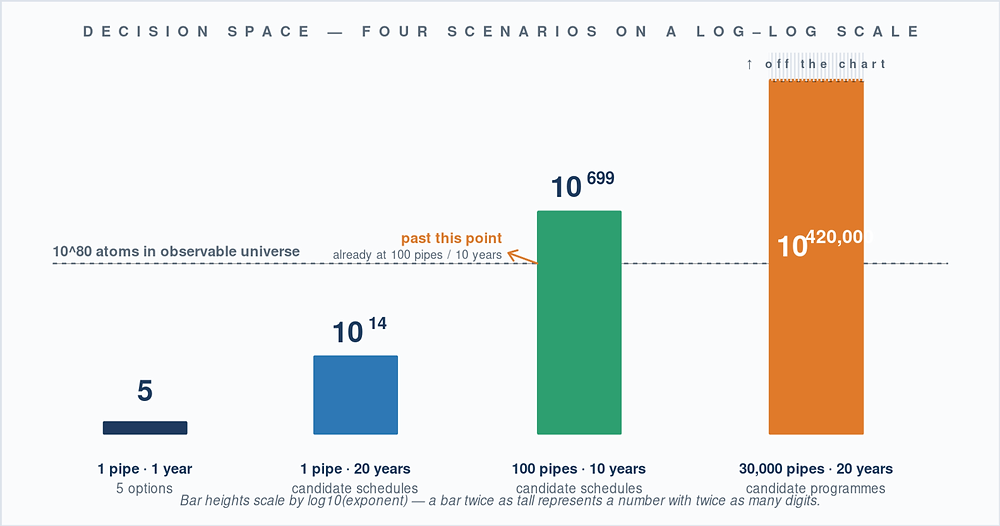
Figure 1. Bar heights scale by log₁₀(exponent) — a bar twice as tall represents a number with twice as many digits.
The practical implication is straightforward: any rehabilitation programme constructed without formal optimisation samples a vanishingly small subset of the solution space, and that subset is almost certainly far from the efficient frontier. Excel-based prioritisation and engineering judgement remain necessary inputs, but they cannot substitute for systematic search.
Three consequences for asset management practice
-
Plan quality. A good plan and an optimal plan are categorically different objects. A good plan reflects experience and avoids obvious mistakes. An optimal plan is the result of a defined objective function evaluated over a structured search.
-
Method. The choice of optimisation method matters. Mathematical programming for tractable subproblems, metaheuristics such as NSGA-II for the full problem, and Monte Carlo simulation to handle uncertainty in deterioration rates and consequence costs (Halfawy et al. 2008; Ana & Bauwens 2010).
-
Objective. The optimum is only as good as the objective function. Capex alone produces a different — and generally worse — programme than one that jointly accounts for capex, operational cost of inflow and infiltration, failure consequences, and service-level constraints. This is the subject of Part 2.
NEXT IN THE SERIES
Part 2 — the cost function unpacked. Capex, I/I-driven pumping and treatment cost, failure consequences, and criticality weighting on a single axis.
Further reading
-
Ana, E. & Bauwens, W. (2010). Modeling the structural deterioration of urban drainage pipes. Urban Water Journal 7(1).
-
Halfawy, M.R., Dridi, L. & Baker, S. (2008). Integrated decision support system for optimal renewal planning of sewer networks. J. Computing in Civil Engineering 22(6).
-
Tscheikner-Gratl, F. et al. (2019). Sewer asset management — state of the art and research needs. Urban Water Journal.
Now in pilot. We are selecting water utilities for the first deployments of the asset-management optimisation module — built on the US-EPA 10-step procedure and the methods discussed in this series. If you operate a network where the techniques could be tried for development, contact pasi.pajula@preventos.fi
—
The optimisation methods in this series rely on integrated, data-quality-scored network condition data. Preventos Hero already provides that backbone in daily production use across Finnish water utilities.